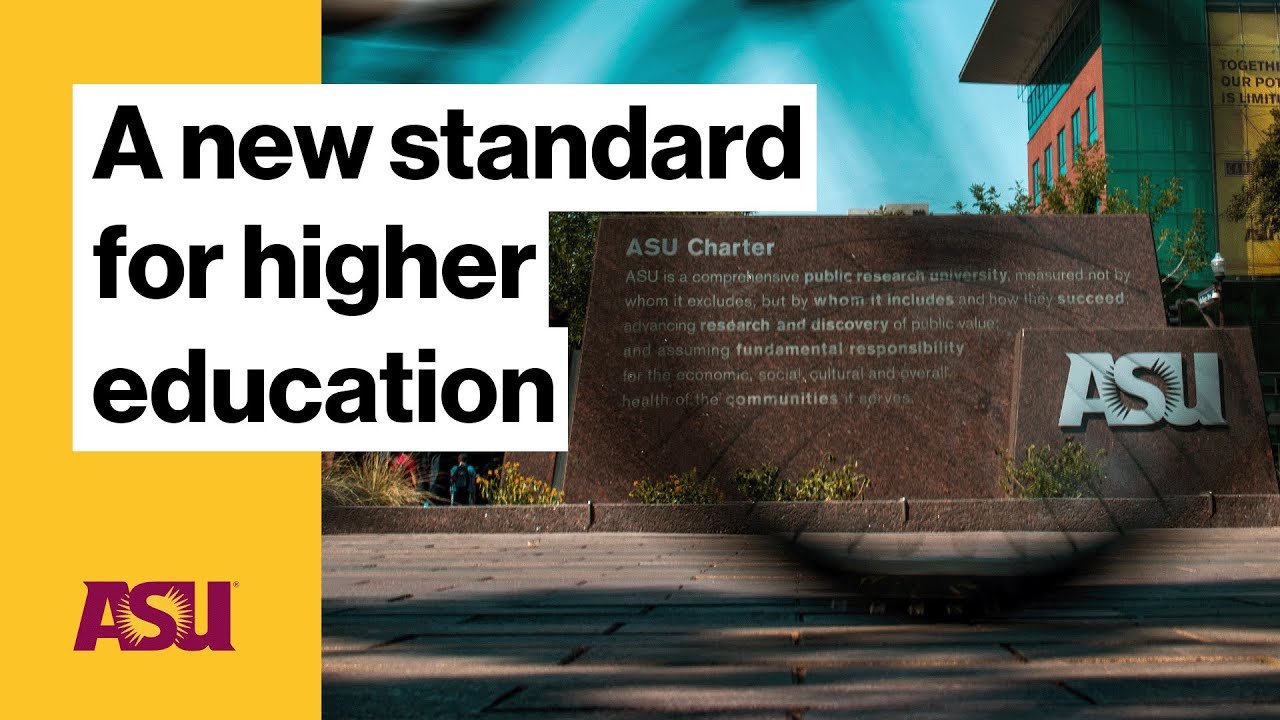
Arizona State University (ASU) presents a clear, repeatable argument for why a modern research university can — and arguably must — be radically reimagined. Under sustained leadership and a deliberately inclusive charter, ASU has combined scale, purposeful innovation, interdisciplinary research, and community impact into a single strategy that’s shaping how universities prepare students, solve problems, and partner with society. Below I unpack the evidence, the mechanisms, and the limits — with dates and sources so you can verify the claims.
1. A strategic vision and sustained leadership
ASU’s approach flows from an explicit institutional charter: measure success by whom you include and how they succeed, not whom you exclude. That ethos has been operationalized by long-running leadership that treats the university as a design problem — reorganizing structures, incentives, and partnerships to scale mission-driven outcomes rather than prestige signaling alone. ASU’s presidential office continues to be an active public voice for reimagining higher education policy and practice. Arizona State University+1
2. Scale + access: serving learners at unprecedented size
ASU has built an enormous enrollment footprint that spans residential and online education. ASU reported total 2024–25 annual enrollment of roughly 194,000+ students (including undergraduate, graduate/professional, and online learners), and ASU Online continued to grow into the tens of thousands — with fall 2025 projections of ~79,000–80,000 online students. That scale matters because it lets ASU experiment, iterate, and invest in systems (technology, student supports, microcredentials) that are simply not possible at much smaller institutions. Arizona State University+1
3. Institutional innovation recognized publicly
ASU’s efforts to redesign curriculum, campus facilities, technology adoption, and public partnerships have earned repeated external recognition. Notably, U.S. News & World Report named ASU the Most Innovative School — a streak continued through 2025. Those rankings reflect the views of college leaders and admissions officers who were surveyed about institutions making major improvements across academics, campus life, technology, and facilities. Such recognition is a signal (not proof) that peers see ASU’s model as a template for experimentation. ASU News
4. Research growth that fuels applied solutions
ASU’s research enterprise has expanded rapidly. According to the latest HERD/NSF reporting published by ASU, the university surpassed $900 million in reported research expenditures for fiscal year 2023 (reported in late 2024). Growing R&D funding enables big, interdisciplinary centers (energy, water, resilience, public health, AI-enabled design) that feed curriculum, startups, and public policy. This research scale underpins ASU’s claim to be a place that both educates and actively builds real-world solutions. ASU News+1
5. New models for learning and technology-led education
ASU has been an early mover on scaled online degree programs, adaptive learning, and partnerships that increase credential portability. ASU Online’s rapid growth demonstrates a capability to deliver entire degree pathways outside a single campus footprint while integrating student supports and industry-relevant curricula. This capacity to serve learners where they are — with credential stacking, workforce partnerships, and flexible pacing — exemplifies a future many universities are now trying to create. ASU News+1
6. Sustainability and mission-aligned impact
ASU adopted ambitious sustainability goals years ago and has invested across operations, curriculum, and research. The university reported achieving carbon-neutral operational goals ahead of earlier deadlines and runs institutional programs focused on climate R&D and implementation. ASU’s climate initiatives and sustainability research demonstrate how universities can pair operational targets with research and education to create demonstrable public goods. (Reporting and commentary around these efforts include both institutional press and independent analysis; the institutional site gives the university’s current metrics and goals.) ASU News+1
7. Translational partnerships and civic economic impact
ASU’s expansion into downtown Phoenix with the ASU Health headquarters and the Phoenix Bioscience Core signals a model where universities drive regional economic development while creating new professional pathways for students. Large investments in health, tech, and community-facing projects create pipelines between research, workforce, and local economies. Initiatives such as SolarSPELL (a solar-powered offline digital library) show how ASU projects are being deployed in both global and local contexts to increase educational access. Axios+1
8. Why this model matters — three structural advantages
- Experimentation at scale: Large, diverse student populations let ASU pilot and iterate educational models (courses, modalities, supports) with statistical power and then scale what works. Arizona State University
- Interdisciplinary R&D feeding curriculum: Nearly $1B in research expenditures lets faculty translate discoveries into teaching, startups, and policy partnerships. ASU News
- Public mission and inclusion: A charter centered on access and measurable student success reorients institutional incentives away from exclusionary prestige toward measurable societal outcomes. Arizona State University
9. Honest assessment — strengths and open questions
Strengths
- Demonstrated ability to scale online and on-campus access rapidly.
- Strong external recognition for innovation.
- A growing research base tied to applied problems (energy, health, sustainability).
Open questions / critiques
- Quality vs. scale tradeoffs: Rapid growth creates extra pressure on student services, advising, and learning quality — areas that require continuous investment and transparent outcome measurement. Independent audits and graduation/placement metrics are important to watch.
- Sustainability accounting: Some critics have questioned how carbon neutrality was achieved (e.g., using offsets or purchase agreements), so transparency in metrics and accounting methods matters. Independent verification and clear reporting of operational vs. scope emissions are essential. State Press+1
- Equity of outcomes: Access is necessary but not sufficient; long-term impact depends on degree completion, employment outcomes, and the removal of barriers for historically underserved students — all areas that need continuous attention and public reporting.
10. What others can learn from ASU
- Design an institutional charter with measurable public value. A clear mission statement focused on inclusion and measurable success changes priorities across hiring, budgeting, and academic programs. Arizona State University
- Invest in scalable student supports that travel with online learners (advising, tutoring, wraparound services), not just in content production. ASU News
- Tie research to regional and global problems — build translational institutes whose discoveries feed curriculum and local economies. ASU News+1
Conclusion
ASU’s model is not a one-size-fits-all blueprint, but it is a functioning prototype of a 21st-century public research university: mission-driven, operationally bold, research-intensive, and purposefully inclusive. Its combination of massive scale, committed leadership, interdisciplinary research, and civic partnerships creates a testbed for innovations the rest of higher education is now studying or adopting. For those reasons — documented in enrollment figures, research spending, sustainability initiatives, and public recognition — ASU is widely seen as leading the conversation about the future of higher education. Ar